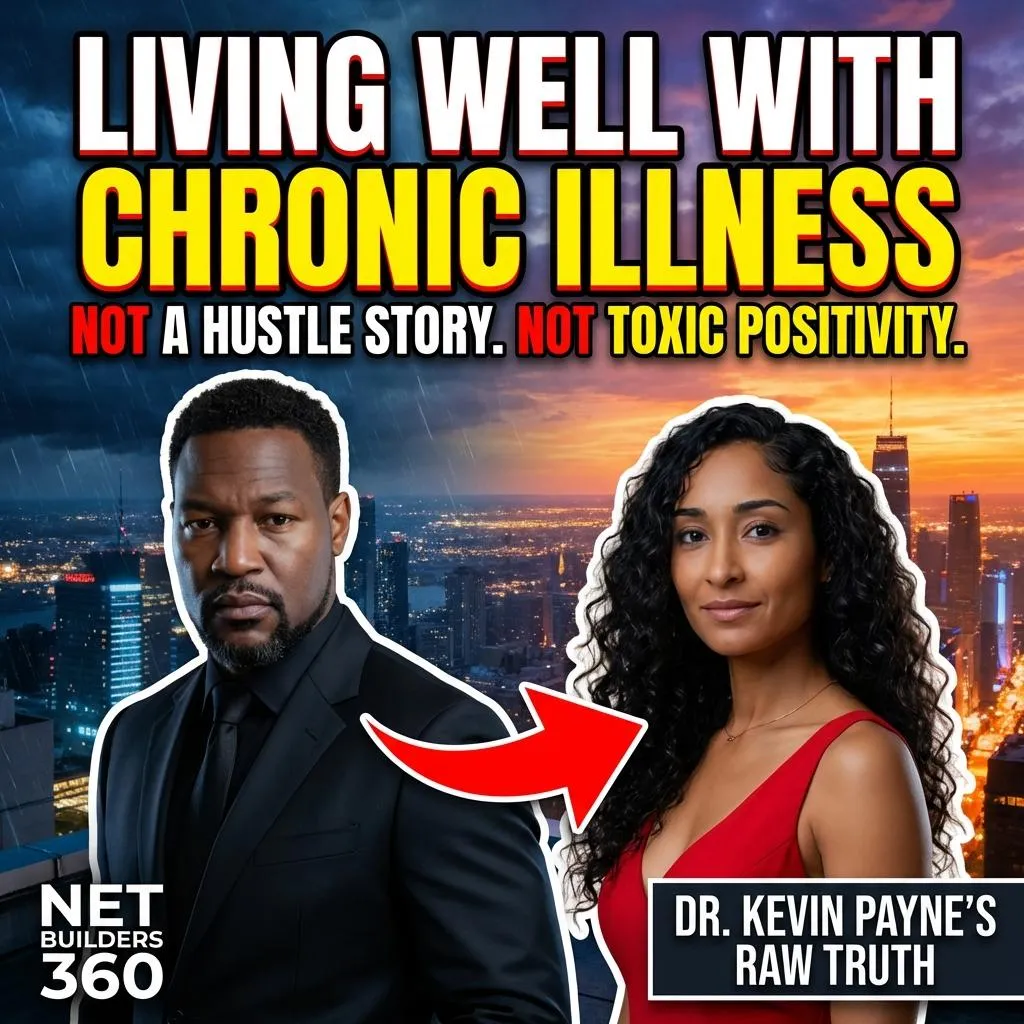
Dr. Kevin Payne Shares Insights on Living Well with Chronic Illness and Overcoming Adversity
Dr. Kevin Payne Shares Insights on Living Well with Chronic Illness and Overcoming Adversity
Dr. Kevin Payne—a sociologist, psychologist, tech entrepreneur, and lifelong advocate—shares his powerful journey of living with chronic illness, caregiving, and choosing joy in the face of uncertainty. Diagnosed with multiple sclerosis after years of misdiagnosis, and shaped by a decade as a caregiver to his late wife, Dr. Payne has transformed adversity into innovation through his startup Your Life Lived Well. His story is about resilience, dignity, and what it truly means to live well—even when life is hard.
A Conversation That Goes Deeper Than Success
In a recent episode of Net Builders 360, we sat down with Dr. Kevin Payne for what quickly became one of the most honest, grounded, and human conversations we’ve had on the show.
This wasn’t a conversation about hustle culture.
It wasn’t about “grinding through pain” or pretending everything is fine.
This was a conversation about truth.
About what it means to build a meaningful life when your body doesn’t always cooperate.
About what happens when science, compassion, and lived experience collide.
And about redefining success—not as achievement alone, but as quality of life.
From RJ’s lens, this is authority earned through experience.
From Noelle’s lens, this is wisdom shaped by vulnerability.
And from every angle, Dr. Payne’s story matters.
Who Is Dr. Kevin Payne?
Dr. Kevin Payne is the rare kind of thinker who doesn’t just study people—he lives inside the questions most of us try to avoid.
He holds a doctorate in sociology and psychology and spent over 30 years studying human behavior, including 15 years as a university professor. His academic career focused on understanding how people think, adapt, suffer, heal, and find meaning within complex systems.
For the past decade, Dr. Payne has also been a tech startup entrepreneur, specializing in research methods, behavioral data science, and applied analytics. His work has helped organizations better understand people—not as metrics, but as humans.
But titles only tell part of the story.
What truly distinguishes Dr. Payne is that his work is inseparable from his lived experience.
Living With Multiple Sclerosis: A Life Redefined, Not Reduced
Dr. Payne has lived with multiple sclerosis (MS) since 1989, though he wasn’t correctly diagnosed until 2006—a reality many people with chronic illness know all too well.
MS is a neurodegenerative autoimmune condition in which the immune system attacks the brain and spinal cord, damaging the protective myelin sheath around nerve fibers. The result? A condition that is unpredictable, deeply personal, and often invisible to the outside world.
Symptoms can include:
Chronic fatigue
Numbness and mobility challenges
Pain and muscle weakness
Cognitive fog
Emotional and neurological fluctuations
And perhaps the hardest part: uncertainty.
Some days are manageable. Some days are not.
Some weeks feel normal. Some seasons feel like survival.
RJ voice: Most people don’t realize the “battle” isn’t always dramatic. Sometimes the fight is waking up, getting dressed, and trying to act normal while your nervous system is doing something you can’t control. That takes real strength.
Noelle voice: And the invisible part is what hurts the most sometimes—because when people can’t see it, they don’t always believe it. Chronic illness can make you feel like you’re constantly translating your reality into a language the world understands.
Dr. Payne doesn’t sugarcoat it. He doesn’t try to “motivate” people out of pain. Instead, he brings language to what so many experience:
Your life can still be meaningful, even when it’s different than you planned.
The Hidden Reality of Misdiagnosis and Delayed Answers
One of the most important parts of Dr. Payne’s story is the timeline: living with symptoms for years before receiving an accurate diagnosis.
That delay is more than inconvenient. It can be traumatic.
When you don’t know what’s happening, you don’t know how to respond.
When doctors don’t have answers, you can start questioning your own body.
When symptoms shift and change, you can feel like you’re losing control of your identity.
And that’s why this conversation matters for anyone dealing with:
Chronic fatigue
autoimmune disorders
chronic pain
long-term caregiving
disability and identity shifts
mental health challenges connected to illness
Because being “strong” isn’t the solution.
Support systems and better tools are.
A Decade as a Caregiver: The Other Side of Chronic Illness
Dr. Payne’s story doesn’t stop at his own diagnosis.
For ten years, he served as a caregiver for his wife, who battled advanced cancer.
If chronic illness is a storm, caregiving is often the part people forget exists. Caregivers become:
the scheduler
the advocate
the emotional stabilizer
the transportation
the researcher
the protector
and sometimes the silent sufferer
Caregiving can be love, but it can also be exhaustion.
It can be devotion—and it can also become isolation.
Noelle voice: Caregivers are carrying two lives at once: the person they’re caring for and the person they’re trying not to lose inside themselves.
RJ voice: And what doesn’t get talked about enough is that caregivers need systems too. They need relief. They need community. They need tools that don’t make them feel like they’re failing.
Dr. Payne’s caregiving experience gave him something most companies in the health space don’t have:
real emotional credibility.
Introducing “Your Life Lived Well”: A Mission Built From Real Life
Dr. Payne’s startup, Your Life Lived Well, is exactly what it sounds like—a platform designed around the idea that people with chronic illness deserve more than survival.
This venture blends:
social science
behavioral science
biomedical insight
technology
and lived experience
The focus isn’t just “treatment.”
The focus is quality of life for:
patients
caregivers
loved ones
and even medical professionals navigating complex, long-term cases
That’s what makes this powerful: it’s not theory. It’s not abstract. It’s built from the trenches.
What “Living Well” Actually Means
In the chronic illness world, “living well” doesn’t mean pretending things are easy.
It can mean:
getting your energy back in small ways
reducing confusion and stress
tracking symptoms with less overwhelm
feeling emotionally supported
having a plan on hard days
finding joy that doesn’t require perfect health
RJ voice: This is authority—because he’s not just talking about “resilience.” He’s building systems that make resilience possible.
Noelle voice: It’s not about being positive all the time. It’s about being supported enough to breathe again.
The Fear He Conquered Isn’t What You Think
One of the most striking parts of Dr. Payne’s story is his passion for skydiving.
He returned to the sport in 2019 to reclaim a childhood dream.
Now, most people would assume his biggest fear was heights.
But Dr. Payne said something that hit like a lightning bolt:
His biggest fear wasn’t the jump.
His biggest fear was the betrayal of his own body.
That is the hidden fear of chronic illness—the feeling that your body has become unpredictable, that it might not cooperate when you need it most.
So what does skydiving represent?
Not recklessness.
Not escapism.
It represents a decision:
“I’m still here. And I’m still alive.”
Noelle voice: There’s something sacred about choosing a life experience that reminds you you’re still capable of wonder.
RJ voice: Skydiving is a metaphor with teeth. It’s him saying: “I’m not waiting for permission from my illness to live.”
Resilience Without Toxic Positivity
Dr. Payne speaks with a rare balance: he’s realistic, but not defeated.
He acknowledges hardship, grief, and pain.
But he also refuses to let those things become the final chapter.
One of his reflections was that life can be viewed as either a comedy or a tragedy—and sometimes the difference between the two is a very thin line.
That’s not denial. That’s perspective.
And perspective matters because chronic illness can shrink your world if you let it.
The mind starts asking:
“What can I no longer do?”
“Who am I now?”
“What’s left?”
Dr. Payne reframes the question into something more empowering:
“What is still possible?”
“How do I adapt without losing myself?”
“Where can joy still exist?”
That shift is everything.
Lessons for Anyone Facing Chronic Illness or Caregiving
Dr. Payne’s story offers real, practical wisdom for people navigating long-term health challenges.
1) You deserve tools, not just encouragement
Motivation is nice. But systems change lives.
If your life is being shaped by symptoms, you need support structures that are consistent.
2) Caregiving needs visibility
Caregivers often burn out quietly.
If you’re a caregiver reading this: your needs are not “extra.” They are essential.
3) Identity can evolve without disappearing
You are not your diagnosis.
Your life may look different than you imagined—but different doesn’t mean less valuable.
4) Joy is not a reward for healing
This one matters.
Joy is not something you earn only when your body gets better.
Joy can exist now—in moments, in people, in small wins.
Why This Story Matters Right Now
We live in a culture that glorifies productivity, performance, and speed.
Chronic illness forces a different pace.
It forces you to redefine:
success
strength
purpose
and what “winning” looks like
Dr. Payne’s life reminds us that adversity doesn’t erase your ability to contribute.
Sometimes adversity becomes the reason your contribution is so powerful.
Because your message comes with truth in it.
Conclusion: You Can Still Live a Full Life
Dr. Payne’s journey is a reminder that chronic illness does not end your story.
It changes it.
It challenges it.
It demands adaptation.
But it does not delete your purpose.
Through Your Life Lived Well, his work is creating real pathways for people to feel supported, informed, and empowered.
And through his personal choices—like returning to skydiving—he shows something deeper:
You can still choose courage.
You can still choose joy.
You can still choose life.
If you’re living with chronic illness, or you love someone who is, let this be your reminder:
You are not alone.
You are not failing.
And you are still allowed to dream.